

Colorado River Compact
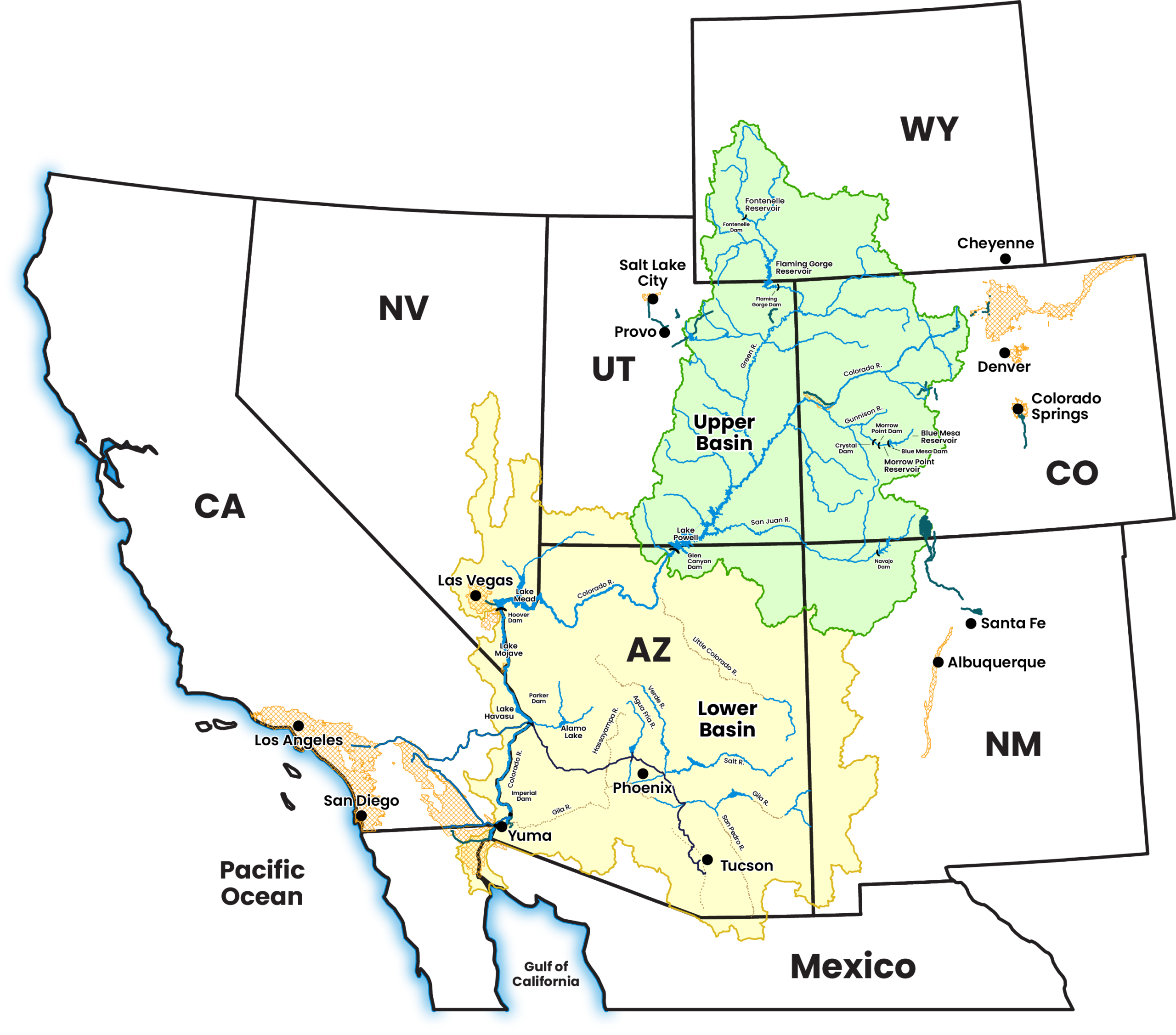
The Colorado River Compact was created to apportion the waters of the Colorado River between Upper and Lower Basins states outside of strict prior appropriation.
In the early 1900s, the American West was growing quickly and competition for water was increasing. The United States government was investing heavily to aid development of the West and its water resources.
The need for the Colorado River Compact arose when Congress required the states that share the Colorado River – Arizona, California, Colorado, Nevada, New Mexico, Utah and Wyoming – to develop a legal agreement for apportioning the water supply before it would approve construction of Hoover Dam and other projects.

Upper Basin Needs Compact
During the time of the Compact negotiations, the U.S. Supreme Court ruled on a case – Wyoming v. Colorado – in which Colorado was advocating for a rule that would have given them rights to all water arising within its borders. The Supreme Court rejected Colorado’s preferred rule and held that prior appropriation could apply between states that share a river where both states employ a system of prior appropriation.
This decision was celebrated in the Lower Basin because it meant that virtually all unappropriated Colorado River water would likely be claimed by the Lower Basin. It was treated as a disaster in the Upper Basin because they were at risk of losing out on this water supply.
Colorado’s lead Compact negotiator Delph Carpenter wrote to Wyoming’s state engineer and lead negotiator Frank Emerson that the Court’s opinion left the Upper Basin “badly exposed” and that, “[w]e simply must use every endeavor to bring about a compact at the next meeting, otherwise . . . we may never again have a like opportunity.”
Who wanted a Compact?
The Upper Basin States (Colorado, New Mexico, Utah and Wyoming) wanted a compact because the Lower Basin was growing its uses of water much faster than the Upper Basin. This pace of development put the Upper Basin at risk of losing this supply due to the law of prior appropriation. Prior appropriation is a legal system of “dibs” – meaning that whoever is first to use the water can claim it in the future to the exclusion of other users.
The Lower Basin States (Arizona, California, and Nevada) wanted a compact to speed federal investment in Western water infrastructure.
Compact Major Elements
The Compact was a compromise to give both basins what they wanted.
- The Upper Basin was protected against the Lower Basin appropriating all the unused waters of the Colorado River.
- The Lower Basin secured the certainty needed to get the Hoover Dam and associated federal projects approved by Congress.
Both Basins also had to give something up.
The Lower Basin could only expect a minimum amount of water from the Upper Basin – 75 million acre feet of water over 10 years plus half of the water required by treaty to be given to Mexico. The remainder could be used by the Upper Basin.
If necessary, due to reduced river flows, the Upper Basin would have to cut its uses in order to make the minimum deliveries to the Lower Basin.
What it means today
The Compact is an agreement that protected both the Upper and Lower Basin interests.
The Compact requires the Upper Basin to ensure the Lower Basin receives its minimum deliveries of 75 million acre feet of water over 10 years plus half of the water owed to Mexico.
If there is more water in the system, the Upper Basin can use all of it so long as the Lower Basin gets the minimum required Compact deliveries. If there is a shortage, the Upper Basin is cut to make sure the Lower Basin gets its minimum water supplies.
Throughout the past few years, the Lower Basin has repeatedly offered proposals that would waive the Compact delivery requirements but would also require the Upper Basin share in the reductions needed to protect the Colorado River’s future.
This is a necessary trade-off so that everyone who is currently using Colorado River water is sharing in the reductions needed to protect its future.