
Living Within the Means of the River:
Everyone Must Reduce Existing Use
We must stabilize the Colorado River system to protect more than 43 million people, agricultural heartlands, ecological habitats, and a $4 trillion economy.
Background
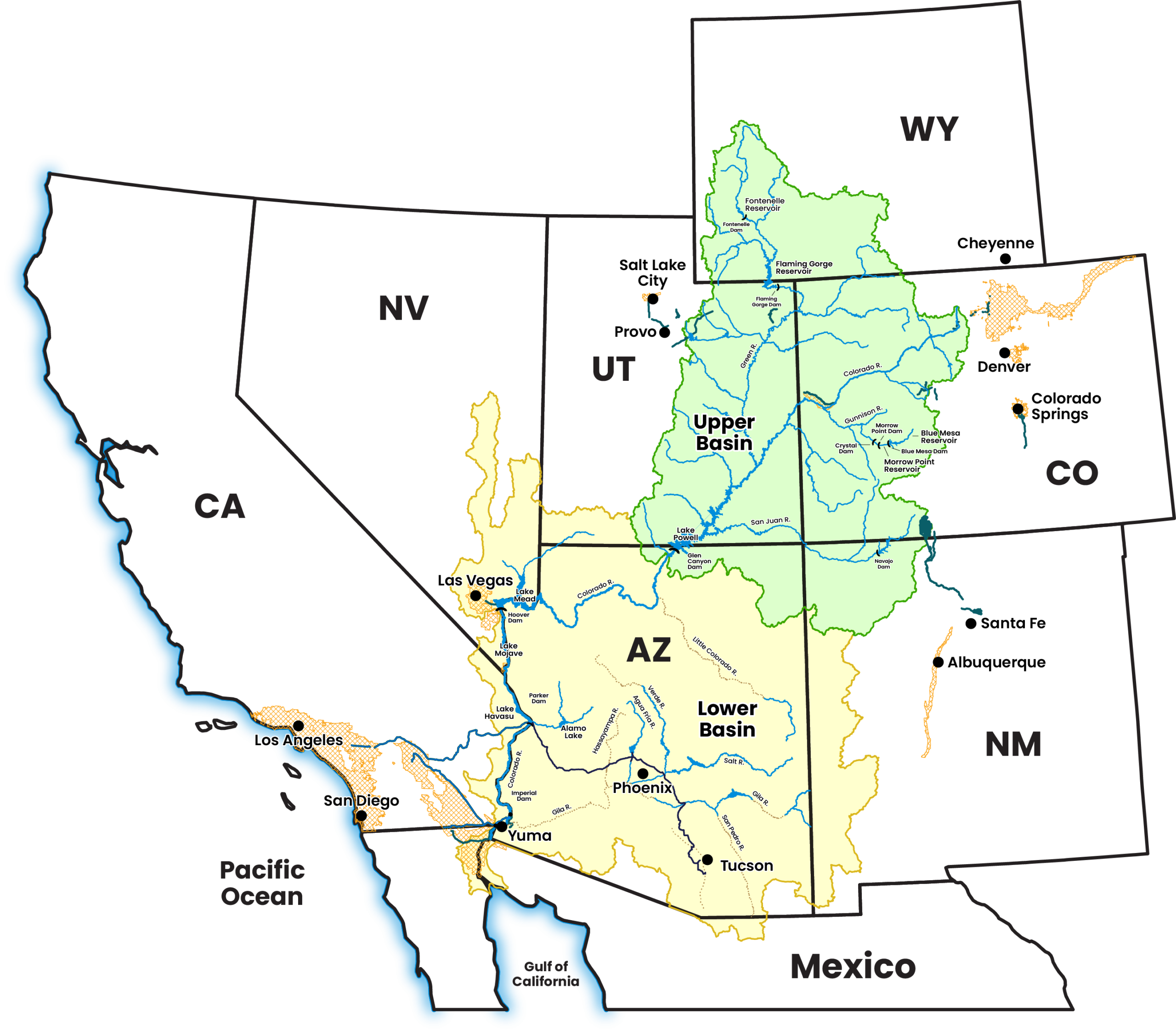
The Colorado River is shared by seven states (Arizona, California, Colorado, Nevada, New Mexico, Utah and Wyoming) and Mexico. The allocations of the river’s water and operations of its dams are governed by the Law of the River; a collection of compacts, agreements, treaties, laws, and regulations that establish how the river is managed.
The water was apportioned based on an inflated belief about the river’s annual flow more than 100 years ago.
Today the river is known to be 20% smaller than
in 2000 and a combination of drought and a warming climate is expected to result in even less water inthe future.
What we need to do
Everyone who uses Colorado River water must reduce their use of this shared resource to stabilize the system.
This means both the Upper and Lower basins must reduce their current uses.

Upper Basin’s “Hydrologic shortage”
Real, meaningful reductions are when a user could take water but instead, leaves it in the system. The Lower Basin has taken 8.9 million acre feet of such real cuts to help save the Colorado River.
The reductions that are necessary from all who share the river must result in more water in the system.
The concept of a “hydrologic shortage” might sound like reductions that benefit the Colorado River system but in reality, they are just the normal process of junior users being cut through prior appropriation.
So-called “hydrologic shortages” are simply implementation of the law of prior appropriation, a byproduct of hydrologic variability and faulty demand assumptions.
Such “hydrologic shortages” taken through prior appropriation do not add water to the Colorado River system or reduce use. They do not help preserve the Colorado River system or increase the amount of water available.
Lower Basin approach
Lower Basin users have been reducing their water use while continuing to grow.
While the major metropolitan areas in Arizona, California and Nevada have seen populations increase many times over during the past 40 years, their water consumption remains roughly the same today as it was in the 1980s. Lower Basin agricultural users have invested millions of dollars improving water efficiencies to increase production using less water.
The Lower Basin is ready to continue reducing its water use to stabilize and protect the Colorado River.
Neither Basin Should Increase Water Use
The only path toward stabilizing the Colorado River is for everyone to reduce existing uses to protect its future. A shared, shrinking resource requires shared reductions.
The Lower Basin wants everyone using Colorado River water to take measurable cuts and has repeatedly offered to reduce its use of Colorado river water to stabilize the river system for everyone.
The Upper Basin has thus far refused to reduce its uses. In fact, the Upper Basin has stated they expect their total water use to increase by more than 700,000 acre-feet of water per year.
*Resolution of the Upper Colorado River Commission, June 14, 2022
It is impossible to imagine a future that requires the Lower Basin to reduce its existing use so that the Upper Basin can use more water.